Blogroll

Friday, April 27, 2007

The Shadow of The Witch

witch shadow

I turned 50 a couple of weeks ago. It was a bit like the fabled Millennium, and the fabled Y2K Bug that never bit; another number, milestone, speed limit, the busy flickering of ghostly symbols in a deserted station. The universe of numbers is just another kind of dream, since we keep waking to the perpetual present where they don't (can't) count. As Eliot put it:

'... the pattern is new in every moment
And every moment is a new and shocking
Valuation of all we have been. We are only undeceived
Of that which, deceiving, could no longer harm."

Or, perhaps more pertinently:

'Fifty today, old lad?
Well, that's not doing so bad:
All those years without
Being really buggered about.
The next fifty won't be so good,
True, but for now—touch wood—
You can eat and booze and the rest of it...'

from 'Ode To Me' by Kingsley Amis

I first came across this in a Penguin selection of Kingsley Amis's poems, which I'd bought in a bookshop near Charing Cross tube around 20 years ago. Far from his best poem, but the first few lines stayed with me for some reason (a few lines later the poem becomes a right-wing rant about 'The Soviet sphere' invading England like Mordor encroaching on The Shire).

The son, Martin, also wrote lines that stayed with me, the closing paragraph from his novel 'The Information', about a writer waking to middle age:

"The Man in the Moon is getting younger every year. Your watch knows exactly what time is doing to you: tsk, tsk, it says, every second of every day. Every morning we leave more in the bed, more of ourselves, as our bodies make their own preparations for reunion with the cosmos. Beware the aged critic with his hair of winebar sawdust. Beware the nun and the witchy buckles of her shoes. Beware the man at the callbox, with the suitcase: this man is you. The planesaw whines, whining for its planesaw mummy. And then there is the information, which is nothing, and comes at night."

That "nun with witchy buckles"... Another incarnation of the woman on the creaky bicycle from 'The Wizard of Oz'. And the man in Amis's book is only FORTY!

For myself, I guess the Information is arriving alright, but in dribs and drabs: no revelationary torrents yet, thanks be to Nothing. I imagine few peoples' lives become as "clear" to them as Philip Larkin's "lading list". Sometimes birthdays can provide miniature clearings (or the illusion of clearings, which about amounts to the same thing). Ten years ago, I opened our front door and caught my first glimpse of the Hale-Bopp comet. Here's the poem I wrote about it:

A COMET AT 4 a.m.

One late last look
before bed, and there
it is, finally, a flared
slightly bigger star
plunging but held,
dissolving in the bluey dark
above sleepshut houses and gardens.
Brightest on April the first,
the day before I turn forty.
Birthday candle, fuse-light,
your failing exclamation mark
will work its way
to the back of the mind,
where I’ve let in these words, minutes
tailing from the earthly core
of a spring morning, here
on the doorstep.


Ten years later, the signs are less rueful. I am married to a wonderful woman and we have a beautiful little boy. Though we woke up Monday morning feeling crap (a stomach bug), we recovered somewhat by late afternoon. My wife brought me a little chocolate birthday cake with one candle and a balloon blazoned with the number in question. Our appetites hadn't recovered yet, but our son had fun blowing out the candle and playing with the balloon (and eating plenty of cake).

That evening we celebrated my birthday in style, with cousins and friends, in Layla, a great Turkish restaurant on Pembroke Street. Someone called for a speech, so I made one (about 10 words, amounting to "thanks everyone"). When they asked for a poem the only vaguely appropriate one I could think of (which I know by heart) was James Fenton's blackly funny 'God, A Poem'. I'm pretty sure this has been widely anthologised, but for those who haven't come across it, here's the opening stanzas:

"A nasty surprise in a sandwich,
A drawing-pin caught in your sock,
The limpest of shakes from a hand which
You'd thought would be firm as a rock,

A serious mistake in a nightie,
A grave disappointment all round
Is all that you'll get from th'Almighty,
Is all that you'll get underground."

So here I am, 50 and still aboveground. I am not yet at that point where, were I to drop dead, people might dust off the platitudes about me having had "a good innings", but I am long past the point where phrases like "so young!" could have any real meaning (no matter what people say about 50 being "the new 40").

Larkin has some resonant phrases for this time of life. In his poem 'The Old Fools' he mentions "extinction's alp", a familiar landmark that "stays in view wherever [younger people] go", but is hidden from the "old fools", since for them it has become "rising ground". Hopefully, I am not one of Larkin's ideal readers, those men "whose first heart attack is coming like Christmas." But I am now in the foothills of Heart Trouble and Cancer Country, even if the lie of the land doesn't seem that threatening. Strange. Death and I are now on speaking terms, though I don't share Emily Dickinson's or Stevie Smith's affection for what Hemmingway called "that old whore". I am in no great hurry to get back to where I am going. Anyway, what's to look forward to? The tunnel of light is here and now, not at the bricked-off end.

The contradictions are gathering, fast and thick. I want to keep living, as long as possible, yet I also want to keep at least a modicum of what makes living worth while: memory, reasonable mental and physical health...all the things you eventually forfeit for longevity, till all you're left with is enough small change to cross the river (sorry; the metaphors, also, are gathering fast and thick). Death or life? Provided extreme pain or depression doesn't make an appearance, there is no contest is there? And if there is a contest, a weighing up? As an old friend of mine once put it, “you might as well stick around for the lightshow.”

Friday, March 30, 2007

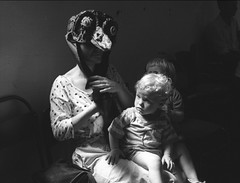
The Mask of Images

Woman in a bird mask


In his often-quoted introduction to Robert Frank’s series of photographs, ‘The Americans’, Jack Kerouac wrote:

'Robert Frank, Swiss, unobtrusive, nice, with that little camera that he raises and snaps with one hand he sucked a sad poem right out of America on to film, taking rank among the tragic poets of the world'.

“Sucked a sad poem..." I’m not sure I even like the phrase, but I’ve never forgotten it. And I am unlikely to forget the gist of the following passages, from Roland Barths’ 1980s book 'Camera Lucida' (Barths admits from the start that he is ‘not a photographer, not even an amateur one’):

‘We might say that photography is unclassifiable. Then I wondered what the source of this disorder might be.

The first thing I found was this. What the Photograph reproduces to infinity has occurred only once: the Photograph mechanically repeats what could never be repeated existentially. In the Photograph, the event is never transcended for the sake of something else: the Photograph always leads the corpus I need back to the body I see; it is the absolute Particular, the sovereign Contingency, matte and somehow stupid…’

‘Show your photographs to someone – he will immediately show you his: “Look, this is my brother; this is me as a child,” etc.; the photograph is never anything but an antiphon of “Look”, “See”, “Here it is”; it points a finger at certain vis-à-vis and cannot escape this pure, deictic language.’

‘The photograph belongs to that class of laminated objects whose two leaves cannot be separated without destroying them both… This fatality (no photograph without something or someone) involves Photography in the vast disorder of objects – of all the objects in the world: why choose (why photograph) this object, this moment, rather than some other? Photography is unclassifiable because there is no reason to mark this or that of its occurrences; it aspires, perhaps, to become as crude, as certain, as noble as a sign, which would afford it access to the dignity of a language; but for there to be a sign there must be a mark; deprived of a principle of marking, photographs are signs which don’t take, which turn, as milk does.’

Sucking a sad [or noble] poem, or souring like neglected milk.

It is good to keep such opposing perspectives in mind. As much as we may be sucking sad (or occasionally happy) poems out of the world, we are also doing the opposite: blowing images into the world, each one another piece, another pixel of that ongoing, worldly collage. Were the final work ever assembled (on some Day of Aesthetic Judgment) it would no doubt already cover the planet. More likely, it would plaster the planet, in the way that a child plasters a balloon with gluey strips of newspaper that will harden into the mold for a papier-mâché mask.

Still, I keep taking photographs, more so than ever these days, with the digital Canon 10D I bought a couple of years ago (vastly outdated now of course, technology on its ever-accelerating treadmill).

What am I at anyway? Why add more images to the mask? The simplest answer is probably twofold: firstly, that this outlet, this means (for framing the world at every turn) is so tantalisingly available; secondly, that I have always been particularly obsessed with the visual; so that my writing is steeped in it. I could ask the same questions of my efforts at poetry. Why more images, metaphors, secular thanksgiving? Most of the stuff written by others and myself is mere wallpaper for our little, laboratory-bubbles of time; they will break on the surface (that calm, unshakable meniscus) without so much as a sigh.

Perhaps this all seems a little moribund and deflationary. Let me make clear that I love photography, almost as much as I love poetry. The first time I got a loan of someone's SLR in 1979 (while working as a KP in Captain America's Restaurant in Grafton Street) I was smitten. I held in my hands a device by which I could frame whatever came within the sphere of my way of looking, my slant, my 'eye'. John Berger (possibly quoting someone else) called photographs 'quotations from appearances', unlike paintings, which are 'translations'.

Photography has become wholly accessible now (to anyone in the First World, that is). We are all adept at pointing and snap/quoting. Does this make it any less exciting? Perhaps it does. But there is still ample room for delight: Mary Ellen Mark's travellers, Koudelka's gypsies and urban landscapes, Salgado's workers, Parr's tourists... For myself, I try to keep a line open to my initial thrill, that first, real buzz in Captain America's.

Can a photograph be a work of art? Even Barthes, for all his scepticism, admits that there is a photographic aesthetic; this is bound up of course in the essential quality of the photograph and its subject (Referent). As Barthes puts it: '...this stubborness of the Referent always being there would produce the essence I was looking for'. Yep. That's what photography is, a great buffalo wallow of referentiality.

Photography, like poetry in some respects (Barthes compares certain kinds of photographs to haiku), is about looking and memory, about the concentrated glance. In that sense, it is primal; we were framing moments of the world long before we had cameras or film.

And before humans happened along the world photographed itself, and keeps doing so, through any odd little hole (in a tree, a cave, a keyhole..): accidental pinhole cameras. Such as the one I was introduced to in the poem below; about a visit to my old friend's little terrace house in Glasthule, Co Dublin:

ART HOUSE
in memory of Trevor Scott

His hall was a narrow dark cubicle. “Do you see it?”
On one wall, a square of soft light – a postcard
cinema – was showing part of a door
and window, the redbrick terrace house from
across the street. Oh. I was inside a camera
obscura, a keyhole lightshow. On cue
an upside down girl in a lilac raincoat walked
past. And the secretive universe blinked.

I see. This is how things take in
each other, how the rays of day enter
a keyhole, dressing a dark, unadorned wall;
how the hinterland composes itself, for itself,
standing as it wants to stand, silent, unadjusted,
on its head, at the apple of its own eye.


(from my collection, 'The Sky Road', published by Salmon in May 2007).

Tuesday, February 20, 2007

On a minor / Major note

Major vs Minor

I recently got involved in a discussion on the subject of being, or wanting to be, a major writer. This itself was an offshoot of another subject, namely Reginald Shepherd's blog about his reasons for writing poetry: Why I Write. I withdrew when our comments seemed to be developing an accretion of misunderstandings. This was at least partly my fault, perhaps wholly so. I was too flippant. Who was I to presume to play the jester in another writer's court? And an articulate writer at that, someone with carefully considered things to say. Nevertheless, some of what I said still holds true for me. As Reginald noted, he and I have different viewpoints. His is perfectly valid, but I believe mine is too.

Like Shepherd, I too would like to think that what I write matters in some way, that it reaches people and (hopefully) moves them; that it might make a reader pause and catch his/her breath as some dormant experience is revitalised, seen anew. That's an exciting thought, that I could embody some essential part of human experience, detach and somehow reshape an eddy from the rushing confluence of life and language; make it real again, give it a coherent worldlet to breathe in. To me, that seems enough to aim for. When I come upon a poet who does this for me, such as Eamon Grennan, Eileán Ní Chúilleanáin or Yusef Komunyakaa, I never wonder whether I may be reading a major writer. Instead, I might (as Larkin put it) think: "That's marvelous, how is it done, could I do it?"

Anyway, I am a little mystified as to what, exactly, denotes a great or major poet or poem. A major poem is, I guess, one that pushes the envelope in some way; not only sitting like a "stone in the midst of all", but also continually broadcasting, sending ripples through the generations. Must a major poem be linguistically innovative, like 'The Wasteland'? I suppose Eliot's modernist enterprise must be major, though I do not understand that much of it, and I get impatient with poems requiring 'Notes'. I love the music of it though, the way it shifts its focus fluidly, like a living thing. I love 'The Four Quartets (more quietly enigmatic but wholly compelling and incantatory) for similar reasons, despite its religious overtones, its occasional high churchy sense of a persona-in-a-pulpit. I trust where these poems take me – their lines that whistle through my mind like a sinewy subway breeze – because they have the capacity to haunt.

I don't wonder very much about whether the poetry I am writing or reading is great. I prefer reading or writing the shorter forms, what one might call ‘suitcase poems’. If I am taken by a particular poem, I like to think that I might be able to carry it (a large part of it anyway) around in my head, like a good song, though of course this isn't by any means an obligatory requirement.

Andrew Motion recently declared that there were only four or five great poets of the 20th Century, one of them being Auden. Perhaps he’s right, but this sounds to me like the kind of sweeping, reductive statement that one often hears from writers trying too obviously to push some agenda. According to Eliot, "the really valuable part" of Andrew Marvell's oeuvre "consists of a very few poems". So should Marvell, or any poet who leaves only a handful of important poems, be considered a great / major poet? If Marvell had only left us one poem, 'To His Coy Mistress' say, would he deserve the title ‘Great’, and if not why not? What's so great about Greatness anyway? Something inside me (a little warning light) begins to blink when I hear a person or country being described as Great: Great Writer, Great Leader, Great Britain. Thatcher was probably a Great Woman, in the same way that World War 1 was The Great War.

Is Greatness the same as Majorness? Pound's 'Cantos' probably qualifies as major, but is it a great work? His imagist gems are the ones that stay in my head (not that my head is some kind of ideal repository). Geoffrey Hill might be a major contender; his work is certainly ambitious enough. 'Mercian Hymns' is marvelous. But it is his short lyrics, 'Ovid In The Third Reich' and 'September Song' for example, that impress me as perfect (or as near perfect as one can get). I believe Frost's 'Birches' and 'Bishop's 'The Art of Losing' and 'At The Fishhouses', are great poems, but are they Great or Major, and should anybody care?

As to whether I will ever be considered great or even good by posterity (whatever that may be), I never give much thought to it. I have my doubts that any of my work will survive, or even get reissued once after I'm gone, or that I even deserve to be remembered, though merit may not have all that much to do with it. I write out of compulsion; an image or half-phrase tugs at me and I follow it. Sometimes I get up to scribble a few lines in the early hours, but more often I find myself redrafting poems that suggest that they may, in time, be made craftworthy. For me, self-doubt is just part of the equipment, like ballast for the hot air balloonist.

Others need to have some ambitious goal in their sights, something not quite over the horizon, and I respect that; whatever floats their boats. But my empathy is reserved for writers like Thomas McGuane, who consider it healthy to embrace one's own insignificance. Here he is in a recent Guardian interview:

"I find it more consoling to think of myself as little than to think of myself as big. I think I've gotten that from animals, particularly dogs. Dogs live such a modest life and they don't live long, and the more you're around them, you kind of accept that. A lot of urban people who are intensely involved in human society seem furious that they're not bigger in the scheme of things." These are the sorts of people who ask, "What is nature for?" McGuane sighs. "Nature's not for anything."

Saturday, February 10, 2007

Permeable or Impermeable

Inis Touch

I remember someone (it may have been one of Don Paterson's aphorisms) comparing a good poem to a kind of secret door in a rock-face; once you found the way in you were presented with an unexpected vista, a whole, roomy landscape you hadn't expected. Then you left the poem, without quite remembering the way in or out. I think I remember Heany talking about something similar, which he might have referred to (riffing on Larkin) as the "poem with a hole in it"; the poem with a certain 'extraness' that resists easy elucidation: once you try to break it down into its constituent parts the door (or the hole) vanishes.

That's one way of putting it, perhaps to close to cod-mysticism for its own good. My point is that I prefer poems with some permeability, that allow for a little absorption. I don’t mind if I am slowed by some surprising linguistic texture, so long as I am able to reach in and explore around it; and so long as its shape seems pertinent to the rest. I can certainly enjoy a poem whose meaning eludes me or at least "resists my intelligence"; I don't think Bishop's At The Fishhouses is 'easy' (not to me anyway), but I trust where it takes me. Its sensuous but exacting imagery has what Reginald Shepherd might call "palpable texture." So does Komunyakaa's Facing It. So does 'The Waste Land'. So do short stretches of The Cantos.

Some poems are all but impermeable though; deliberately flat, fragmented, disassembled then bodged together again with parts conspicuously missing. You can solve such poems in the way you can a crossword puzzle, if you're good at cryptic clues and allusions. But it seems a thankless task to me (I'll admit I'm crap at crosswords).

Auden (who sang the praises of the permeable limestone landscape) called poetry "memorable speech." I think great, or even just good, poems should have at least an element of this; they should resonate in the way that a good song or piece of music does. If they manage that I will forgive them much, including a good deal of impermeability.

Saturday, January 27, 2007

What One Note Holds: The Short Poem


How short can a poem be, if it is to remain a poem? The Scottish poet and artist Ian Hamilton Finlay wrote a series of one-word poems (though the titles were often considerably longer). There are poems with no content, only titles, such as Don Paterson's 'On Going to Meet a Zen Master in the Kyushu Mountains and Not Finding Him', or James Wright's 'In Memory of the Horse David, Who Ate One of My Poems'.

I like those two, but often the 'litty' combination of brevity and levity falls far short of the mark set by the best comedians. Take Woody Allen's 'Eternal nothingness is fine if you happen to be dressed for it' or 'I am at two with nature'. Then there's Groucho Marx's delightfully surreal 'Outside of a dog a book is a man's best friend. Inside of a dog it's too dark to read.'

Essentially, very short poems are not that different from other kinds; they work (or fail to work) for much the same reasons longer poems do. So a short poem, like any other, isn't a poem when it is ONLY a set-up for a punch line, a sentimental platitude or a statement (political or otherwise) that would be better served in prose.

But what should one make of the following?

IMAGE

Old houses were scaffolding once
and workmen whistling.

Some would dispute that T.E. Hulme's couplet is in fact a poem. I think it is (and so did Larkin apparently, who included it in his Oxford anthology). For me, the poem manages a kind of magic, a cinematic, reverse-time-lapse effect, running history backwards, undressing all those gaunt, respectable old houses we've seen and momentarily wondered about, leaving civilization without its facade, but with a cocky, human note, almost the air of a song. Hulme wrote little poetry (his Complete Poetical Works when it was published in The New Age in 1912 consisted of five poems); so it is remarkable that he is acknowledged as the founder of the Imagist Movement, which had such an important influence on Pound.

Many approximations of haiku, tanka, epigrams etc. have as much substance as soap bubbles, and none of the buoyancy. But when very short lyrics work they can trigger what Tobias Wolff might call 'synaptic lightning', allowing the reader to enter a space as startlingly expansive as the interior of Dr. Who's Tardis. Pound has some fine examples, such as his 'And the days are not full enough':


And the days are not full enough
And the nights are not full enough
And life slips by like a field mouse
      Not shaking the grass


The kind of short poems that interest me are usually those with strikingly effective imagery, though there are exceptions, such as Oppen's 'There is the one word...'.

I've been reading Kuno Meyer's recently reissued 'Ancient Irish Poetry', which has a number of epigrams and short poems. Here's his translation of an anonymous poem from the 9th Century:

THE VIKING TERROR

Bitter is the wind tonight.
It tosses the ocean's white hair.
Tonight I fear not the fierce warriors of Norway
Coursing on the Irish Sea.


D.H. Lawrence wrote some memorable short lyrics. I took out my hefty Penguin edition of his Complete Poems, thinking I might discover many that were new to me (or that I had forgotten). I was a little disappointed to find only a few more short poems that held together for me, and to realise that many were rather dull. But I also came across some interesting things. The first paragraph of his introduction to his 1929 book, ‘Pansies’, is worth quoting:

“These poems are called ‘Pansies’ because they are rather ‘Pensées’ than anything else. Pascal or La Bruyère wrote their ‘Pensées’ in prose, but it has always seemed to me that a real thought, a single thought, not an argument, can only exist easily in verse, or in some poetic form. There is a didactic element about prose thoughts which makes them repellent, slightly bullying… We don’t want to be nagged at.”

Indeed; few people desire to be nagged at, or to read nagging poems. Lawrence wrote some remarkable poetry, especially about animals and plants. But he had very definite, often irritable and dogmatic, ideas about many things. Too often, the short poems are bursts of invective, flak from some war he seemed to be engaged in with certain kinds of English women and men; many amount to little more than framed Opinions. He acknowledges as much himself in the second paragraph:

“So I should wish these ‘Pansies’ to be taken as thoughts rather than anything else; casual thoughts that are true while they are true and irrelevant when the mood and circumstance changes. I should like them to be as fleeting as pansies, which wilt so soon, and are so fascinating with their varied faces.”

The weaker poems in ‘Pansies’ (and in Lawrence’s ‘Complete Poems’) are probably true enough to their time, though hardly less didactic or bullying than equivalent prose thoughts, and likely more pretentious. But the best of Lawrence’s short poems, just a couple of handfuls, are more than casual thoughts; these are perpetually fresh, classics of the genre.

So here is my nosegay:

THE WHITE HORSE

The youth walks up to the white horse, to put its halter on
and the horse looks at him in silence.
They are so silent, they are in another world.


THE RAINBOW

Even the rainbow has a body
made of the drizzling rain
and is an architecture of glistening atoms
built up, built up
yet you can't lay your hand on it,
nay, not even your mind.


SEA-WEED

Sea-weed sways and sways and swirls
as if swaying were its form of stillness;
and if it flushes against fierce rock
it slips over it as shadows do, without hurting itself.


NIGHT

Now that the night is here
A new thing comes to pass, eyes close
And the animals curl down on the dear earth, to sleep.
But the limbs of man long to fold and close upon the living body
of another human being
In shut-eyed touch.


NOTHING TO SAVE

There is nothing to save, now all is lost,
but a tiny core of stillness in the heart
like the eye of a violet.


LIZARD

A lizard ran out on a rock and looked up, listening
no doubt to the sounding of the spheres.
And what a dandy fellow! the right toss of a chin for you
and swirl of a tail!

If men were as much men as lizards are lizards
they’d be worth looking at.


NON-EXISTENCE

We don't exist unless we are deeply and sensually in touch
with that which can be touched but not known.


RELATIVITY

I like relativity and quantum theories
because I don't understand them
and they make me feel as if space shifted about like
a swan that can't settle,
refusing to sit still and be measured;
and as if the atom were an impulsive thing
always changing its mind.


LITTLE FISH

The tiny fish enjoy themselves
in the sea.
Quick little splinters of life,
their little lives are fun to them
in the sea.


Contemporary poets continue to be fascinated with making less more. Longley is obsessed with the short, imagistic lyric, and has written some memorable ones, Mahon too, and Heaney ('The dotted line my father's ashplant made...'). Muldoon's CRADEL SONG FOR ASHER is perhaps one of the greatest short lyrics of the century.

I've already written in an earlier blog about my recently deceased friend Anthony Glavin, who spent a couple of decades working on a long sequence of stunning 4-line poems, 'Living In Hiroshima'. If you're interested in seeing just how much it is possible to pack into such a small form, click on my entry for December 2006 and scroll down.

Here are four of my own shorter poems, the first two, DREAM ON and LIGHTBOX, are from my new collection, ‘The Sky Road’ (due from Salmon in April 2007). A 'lightbox' (from which I took the name of my blog), also called a roofbox, is the name given to the rectangular stone fanlight above the entrance to Megalithic passage tombs at Newgrange and elsewhere, angled to allow the rays of the sun to penetrate to the heart of the tomb.

The third poem, VANISHING POINT, is from my first book, 'Airborne':


DREAM ON

That little seal
of ownership, your fingerprint
on this mug of cold tea, after you're gone.


LIGHTBOX
(Newgrange)

Everyone should have one
dark hub for the dull day’s orbit:

stoneshouldered wings
where you bury the bones

of belief, and the redfaced sun,
to gain entrance, turns

a skeleton key.


VANISHING POINT

Simply staring
into the space ahead
is not enough; there is
the traffic of eyes to be met.


DARK MUTTER

Everything tends
to its own ends.


And my own haiku joke:

HAIKUISH

Haikush
Hash –
Ha
!

And finally, two from my recent collection, 'Fade Street', including my only one-line poem (or monostich):

NIGHT, WIND, DEAD LEAVES

rattle and hiss, the sound so high
it is almost a whistle,

their bodying sigh
the air of something more palpable

than passing by.


GHOST STORY

'Listen hard enough and you wake the dead.'

Thursday, January 18, 2007

A Little Manifesto For Langpo

Dissatisfied Square Number 7

If the picture above reminds you of anything outside itself – or its=elf – forget it (unless, like Borges's Aleph, it reminds you of EVERYTHING outside itself)! Away with meanings and burdensome referentiality. These are just hangovers from our infantile need to web everything in language, a nasty thing really; how dare it mean anything! Why speak when you can grunt, and IF you can grunt why grunt? Better to sigh when a grunt is expected, to translate yawps into barbaric giggles. One should be miserly with words that mean anything other than their own little packets of breath; unless, of course, the packets are burst, like the inadaquate condoms they are, scattering spent meanings everywhere. The point is, to be mean with those words that THINK they know what they mean. To refashion Wallace Stevens's epigram: there is no wing like meanness.

Lithograph: 'Dissatisfied Square Number 7' by Camille Scott
© Camille Scott 2003

Monday, January 01, 2007

Tuesday, December 26, 2006

Fancy a swim? Season's Greetings from Naylor's Cove, Bray, mid-1980s

Winter in Bray, Co Wicklow, 1980s

I lived in Bray for awhile in the late 1970s, in a mouldy, crumbling Victorian cottage beside the sea. As with various other dwellings over the years, I shared the rent with a number of friends/cousins. Most of the days passed over me in sleep, after nights of interminable talk about everything and nothing at all. I used wake sometime in the afternoon and saunter out about my never very pressing business; a youthfully retired life in a town that seemed (in my ignorance in these matters) happily in accordance with the general mood.

The photo above (of Naylor's Cove on Bray Head) was taken in the 1980s. This is first cove you encounter, coming down from that steep pedestrian walkway after the Bray Head Hotel. Crowded in summer, cold and lonely in winter. But during the 70s we'd go there some evenings to sit and smoke and skip stones across the water. There was a neglected, narrow, concrete wall, the remains of a swimming pool or small pier, broken in places, chewed and mauled by the sea. At its end was what I assume had once been a diving board, though only the concrete stand remained, like the crude sculpture of some long-necked animal. We called it 'the dinosaur'. There's no sign of it in the photograph (though I think it may have been a little more to the left). Anyway, the sea had probably consumed it by that stage.

BRAY ABODE

By the 1980s, the cottage we had once rented was already derelict looking (see photo above), but the seafront had not altered greatly; it still seemed submerged in the drowsy, drawn-out aftermath of its status as a popular Victorian/Edwardian Prom.

Myself and my cousins (Dave and Pat and his children) came to live in Bray again in the 1990s. We rented a flat in Westview Terrace, near the station, then moved to the grander-sounding King Edward Lawn, nearer the town centre, where we shared a house with a young mother and her child. Dave, Pat and myself joined a FáS scheme and became involved (with Jim Morrison and others) in setting up an arts centre in the little laneway behind our flat on Westview Terrace, Albert Walk. We had a meeting to vote on a name and I came up with The Signal Arts Centre (since it was only yards from the station).

One evening in 1990, myself and my girlfriend, D, were sitting in the spacious lounge of the old Hibernia Hotel. We had being going out for around three months and had, just that moment, almost agreed (more or less mutually) to break up. We became aware of movement around us, unhurried but purposeful. People were leaving their seats, gravitating towards the bar and the small crowd gathering there below the wall-mounted TV. Was it the grainy green night-visions of ordinance zipping across the Iraqi desert (unreal-looking as Captain Picard's proton torpedos) or did those come later? In any case, we learned that it was official, the Gulf War had just broken out. And so our breakup became postponed for a few weeks, put on the back shelf. Both of us would stay up late watching TV in her place (as in the photo below), keeping track of the changing 'world order', the Shock and the Awe:
Staying Up, Watching the Gulf War, 1990
By this stage, the town had woken after its century-long doze (or perhaps it was merely ourselves who were finally stirring) and our old cottage, along with its neighbors, was quickly gobbled up by the metastasizing Dawson's Amusements, visible as the hottest cluster of lights on the left in the (colour) photo below:
Night, Bray seafront
Bray can still occasionally warp into its older self, especially in winter when the wind and rain rolls in, the coloured lights go out on the Head and the seafront empties, as in this photo I took of my cousin (with an unrelated dog) in the early 1990s:
Bray Co Wicklow: Dave & dog
But I am glad to see that, two decades later, it is still all go at The Signal Arts Centre which has moved down the lane to a larger premises on Albert Avenue.

Monday, December 04, 2006

Anthony Glavin: 1945 – 2006

Poet, music teacher, friend, mentor, bright spirit.

Antthony

One of the brightest lights in my life, my friend Anthony Glavin, died on Tuesday 14th November after many years of suffering with emphysema. He was 61. The following week I put together an obituary with the help of his friends and family, particularly his sister Irene (she and her husband Mike, were Anthony’s primary carers). Below is an edited version of the obit, followed by further details and personal reminiscences about his life and work.

Anthony Glavin, who died at the age of 61 in the Mater Hospital, was a poet and Professor of Music at The Royal Irish Academy. He was born in Dublin on August 7th 1945 to Kathleen and James J. Glavin. Anthony’s father fought in The War of Independence and later went on to work for the Irish Sugar Co. (Comhlucht Siúicre Eireann, Teoranta) till he retired in 1971.

Anthony was educated at Scoil Uí Chonaill, North Circular Road, where he excelled at drama and music, eventually studying at The Royal Irish Academy where Dina Copeman was his tutor. He regularly entered the yearly Feis Ceol and came first many times, competing with musicians such as John O’Conor and Micheál Ó Ruairc. Each year he played one of the lead parts in the school’s production of Gilbert and Sullivan.

After leaving school Anthony studied at University College Dublin and Trinity College. In 1963, during his first year at UCD, he was approached by the Rathmines and Rathgar Musical Society and played Jack Point in The Gaiety’s production of Yeoman of the Guard. It was also at UCD that Anthony took over from Harry Crawley as Auditor of the Literary and Historical Society and presided brilliantly over the Saturday night sessions and debates. His sister Irene also used to attend these debates, which were open to the public; she recalls what a gifted speaker her brother was, and how she could depend on having a wonderfully entertaining evening. During this period Anthony was active in the UCD drama society, Dramsoc. His friend the writer Thomas Tessier remembers him giving an electrifying performance as Father Grandier in John Whiting's play The Devils, directed by Colm O'Briain.

Anthony received his Licentiate from The Royal Irish Academy of Music and joined the staff there in 1969. During the 1980s he served on the RIAM Board of Governors. He was an outstanding teacher, a nurturer of talent and friendship who forged strong relationships with his students and their families. Many of his students went on to become distinguished singers, teachers and musicians such as Peter Tuite, who won the European Musician of the Year Award; also Sarah, John and Michelle Picardo, Niamh McGarry and Robin Tritschler, who read and performed at his funeral service. Anthony was a highly valued and much loved member of staff at the RIAM, which was very supportive of him during his long illness. On the day of his funeral the RIAM held a half-day of mourning and one-minute silence in memory of Anthony’s unique contribution.

Anthony began publishing poetry and reviews while at university. His poetry appeared in numerous newspapers and journals and was first anthologised in ‘Irish Poets 1924-74’, edited by David Marcus. Anthony won the Patrick Kavanagh Award in 1987 and his poetry collection, ‘The Wrong Side of the Alps’, was published by Gallery Press in 1989. The following year he received an Arts Council Bursary and his collection was shortlisted for The Irish Book Awards. Reviewing ‘The Wrong Side of the Alps’ for Books Ireland, Fred Johnston wrote that ‘it is a fine, meticulous book’ and ‘there is, to quote Glavin himself, “a weightless perfection” about most of these poems.’

Anthony could easily have gained prominence as a well-known and highly acclaimed poet. However, a combination of relentless perfectionism and his worsening illness led to his reluctance to publish more than one collection. Before and during his illness Anthony was working on a long, ambitious sequence of four-line poems, the first three sections of which were published in his Gallery Press book. The following poem (published in PIR 87) is taken from this sequence:

AN AFTERLIFE

Suddenly, glass to lips in the ballyhoo
Of the 'Open Bar' after the Service, I knew

The bewildered and unbewildered carrying on
Would all end dedicated to you.

Anthony is survived by his two sisters, Irene and Anne and his brother Frank. There will be a celebratory concert and poetry reading in memory of Anthony at The Royal Irish Academy of Music, Westland Row, Dublin 2 on December 20th. For further information contact the RIAM at 01 6325300.


Anthony was first introduced to me by a mutual friend in the mid 1970s. From the moment I met him I knew I was in the presence of someone special, a mind extraordinarily alert and self-possessed. In the late 1980s we began to meet more regularly and became close friends.

We often clashed. I was prone to dreamy absentmindedness, to catching only the tail-end of one of his carefully worded sentences, and (worse still) making do with my half-comprehension. Anthony was exactly the opposite. He had the quickest mind of anyone I’ve ever known and an impatience to match. I can think of no one who would suffer fools less gladly. But, even at his most argumentative, he was often invigorating; there was always the possibility of some minor revelation, the chance that this time we might have a “nice little canter.” I will miss these; also his warmth and his fierce loyalty. Anthony was an Hour of The Wolf friend, someone you could call at three or four in the morning, whether you were in trouble or merely feeling troubled.

Anthony came close to dying more than once over the past decade, when the drugs and ventilator seemed inadequate. I remember one occasion, in St Michael’s in Dún Laoghaire, when he was convinced that his time was imminent. On that afternoon he was prepared, grateful to be able to say goodbye with grace. Borrowing a line from the film ET, he pressed his fingertip to my forehead and said: “I’ll be right here.”

I will also miss Anthony’s wicked and mischievous humour, which survived despite all the ravages of emphysema. He loved all kinds of wordplay: from filthy limericks to puns (including visual puns), spoonerisms, deliberate slips of the tongue. Any occasion might offer an opportunity. When he was still able to get about, with the aid of a portable oxygen tank with nasal tubes, he was queuing for an ATM when he noticed that the woman in front of him was wearing the same gear. He tapped her on the shoulder. When she turned round he said, "snap!" She got the joke and laughed.

I have already mentioned Anthony’s work of half a lifetime, the ambitious sequence of quatrains, originally titled ‘Living In Hiroshima’. Anthony was haunted by the fact that his birth-date, the 7th of August 1945 (a Bank Holiday in Ireland), was just one day after Little Boy was dropped on Hiroshima; that his coming into the world coincided with an event that abruptly altered the world’s “historical velocity.” As the title of the first poem in the sequence (taken from a Time article in 1985) puts it: “Everybody lives in Hiroshima.”

When Anthony received his Arts Council Bursary in 1990, his intention was to travel to Japan, to visit Hiroshima and Nagasaki and supplement his extensive research with actual experience. He had asked me to accompany him, as a friend and fellow writer, but also for more practical reasons. Though he could still drive, his emphysema had already reached that stage necessitating that someone be on hand as a kind of minder. Alas, the trip had to be cancelled; his doctor advised that such long-haul flying would be risky for someone in his condition.

Though the sequence includes much about the actual explosion and its after-effects (all diligently researched), it also encompasses many other fragments, what Peter Fallon called “glancing images”, from 20th Century history. Some of these are from Anthony’s personal history, such as his “push for freedom” on that particular Bank Holiday weekend, or his love life, travels, “wrestling with words and meanings”. There are moments of delighted epiphany, bleak self-scrutiny, wrenching horror (from Hiroshima, Nazi and Japanese war crimes) and pitch-black humour, all of them referencing and calling to each other as much as to what lies at the radiant hub of the sequence. This is part of the rhythm of ‘Living In Hiroshima’; each poem, however self-contained, affects and is affected by that blind(ing) spot at the centre.

The completed sequence, had he ever finished it, might have contained 250 of these ‘hironyms’, making 1000 lines in all. That was one plan anyway, inspired by the Japanese paper crane ceremony, in which the act of folding 1000 origami paper cranes may touch (or save) one human soul. I am not sure that this plan was ever abandoned. But Anthony was a relentless perfectionist; with his worsening illness, it demanded all his energy to redraft small sections, then, eventually, single poems, attempting to salvage as much as he could from the project. Had Anthony managed to complete ‘Living In Hiroshima’ I have no doubt that it would have been a major 20th/21st Century work. However incomplete though, it is still a brilliant and unique sequence. Happily, many of the single poems function, not only as part of that sequence, but in their own rights, as compact and coherent worldlets.

Here are just five more of them, to give some sense of what I mean:


PRAYER*

It was said a thousand cranes made of
Hand-folded paper would be enough

To save a life.
Some days you wouldn’t know what to believe.


VOYAGER TWO

Leaps past Triton at 17 miles a second –
Wolf-howl, birth-cry, greetings from a one-time Nazi

Packed in a space the size of the human psyche,
Headlong to the limits, a feeler, beyond the beyond.


IT’S A SILENT RHAPSODY

Holds open the guestroom door we couldn’t close
The whole high summer we lip-read through at body-heat

Counting on one another’s heartbeat
And not making love because the noise, the noise…


LOWELL TO T.E.HULME*

My mind’s not right, but with my ear to the ground
I heard the bass growl of Hiroshima

And a beating-out of images that enlarge the heart.
Is nothing bad in itself except disorder?


ANCIENT MARINER

So distant the Antarctic slippage
Capsizing ocean

And that soft sighing you hear as an
Albatross, winging it, somewhere, at the very edge –


* The two asterisked poems were published in PIR 87. The title of the latter refers to the poets Robert Lowell and T.E. Hulme.
Hulme was probably the originator of the early 20th Century Imagist movement, which influenced Pound's poetry. He was also a Tory. The last line is a paraphrase of his statement "Nothing is bad in itself except disorder" (from 'A Tory Philosophy').

All poems copyright of the Anthony Glavin estate. All rights reserved.

Thursday, September 21, 2006

The Night of the Triffids

Blackrock fireworks

Around midnight, Saturday 16th September, our road’s relative tranquility was put on hold for the best part of half an hour. It began with a series of quick percussive bursts: BOFF! BOFF-BOFF-BOFF!! BOFF! Three possibilities immediately presented themselves: gunshots, a car backfiring or fireworks. The first is not quite as wild as it might seem. At least one neighbor has a shotgun. I know this because a few years ago he blasted it over the heads of some guys who were busy trying to break into his car. Not a good idea. He had upped the ante and the following night the same car got petrol-bombed, the first (and hopefully last) of such incidents on our road.

Anyway, my neighbor had presumably learned his lesson, so such recklessness seemed unlikely. Even less likely was the possibility of anyone in the whole of Dublin (let alone this leafy, Southside, four-car-family neighborhood) possessing anything as quaintly anachronistic as a backfiring ‘banger’. So fireworks seemed the most probable explanation. Had some calendrical Red Letter Day failed to glow on my mental dashboard? Not impossible. I regularly forgot St. Valentine’s Day. It wasn’t Halloween yet, was it? No, that was October.

I stepped outside to investigate, just in time to be aurally (and now visually) assaulted by another series of bursts, this time much longer: a whole sizzling sky-pond of flash-in-the-pan life: abruptly unfurling pink chandelier-jellyfish, limegreen dandelion clocks, fountain-flora and fauna of all shapes and sizes. It was one of the most spectacular display of fireworks I’ve even seen, far more startling than our Millennium-fevered suburbs on midnight 1999, when every family in the neighborhood seemed to be either lighting fireworks or standing gawking at them, and every car alarm went off like a drunk on an all-night singing-binge.

Apart from its being unheralded, what made this blitzkrieg so impressive was the absence of people. I saw only two slightly bemused neighbors wander out to see what the noise was, then wander in again when they realized World War Three hadn’t been declared yet.

The launching pad for this display was obscured by the tall buildings of the old Carysfort Convent (a business school for many years); it was probably in the park out the back or perhaps on the grounds themselves. I grabbed my camera and ran some way down the avenue, snapping as I went; no telling when this would suddenly finish. Very few cars passed, and even less people. Above the gently-curving road with its tall poplars, the sky continued to crackle and bloom. I could actually smell the acrid (gunpowder? cordite?) and make out thick, discarded veils, conveyed by a swift warm wind over nearby rooftops and gardens, perhaps stealing into the occasional open window, where someone might wake coughing in a roomful of smoke, and wonder if the house was on fire.

This could hardly be legal. But I heard no sirens. The contrast between the seemingly unstirring world and exploding sky was eerie. Who would do such a thing? A group of rich kids launching one of their friends’ birthdays in style? I imagined a big gathering, of students perhaps or beer-guzzling gougers who’d managed to put their thieving hands on someone’s Halloween cache. I’d probably never know. So it might as well be for me, a whole shitload of shooting stars to wish upon.

Also big pain in the arse of course. I wouldn’t be the only one with a frightened toddler who could take half the night to be persuaded back to his cot. Or neighbors with cats or dogs, their hackles raised, trembling under tables and chairs. But such considerations were, for the moment, blasted out of my mind. I came to a halt halfway down the avenue and just stood gaping, not shocked but certainly awed, as if the earth itself had forgotten its respectable, crusty age and was lost in a Pre-Cambrian dream of juvenile ecstasy, splitting its sides with laughter that might go on for years, epochs.

Friday, August 25, 2006

The Twittering Machinist

Times Square, Sydney

I recently found my old copy of The Diaries Of Paul Klee, 1898-1918 (University of California Press, 1968). Opening the book at random, I found these two marvellous entries:

954. Dream: I asked the geishas only for a little music and some “of the tea that serves as a manifold substitute for all the geishas of the world.”
At the slightest temptation I heard a soft knocking. When I followed the knocking, a small sprite stretched out his tiny hand to me and led me gently upward into his region.
There, things fell up, not down. A light breakfast, including eggs, was appetisingly laid out on the ceiling.

956. What the war meant to me was at first something largely physical: that blood flowed near by. That one’s own body could be in danger, without which there is no soul! The reservists in Munich, singing foolishly. The wreathed victims. The first sleeve turned up at the elbow, the safety pin on it. The one long leg, clad in Bavarian blue, taking huge strides between two crutches. The actualization of the letter of the history book. The coming to life of the pages of old picture books. Even though no Napoleon appeared, but merely a lot of Napoleonettos. The whole business had as much sense to it as a wad of dung on a shoe heel.

These are diary entries on two completely different subjects, a seemingly pleasant dream and memories of the First World War (in which Klee was a Private). They are united by the delicacy and meticulousness of Klee's description, his eye for the surreal, eidetic image. Nothing is over-explained; the sensory details are given without embellishment and the effect is both mysterious and utterly down to earth, much like Klee's paintings and drawings.

There are many of these that stay in my memory. One of the first I encountered (in a book) was The Twittering Machine, a sketchy cartoon depicting some kind of organic-mechanical apparatus involving birdlike heads and a winch. I am reminded of street organs, birds on a wire, and (out of my personal rag and bone shop) Yeats’s Byzantine bird ‘of hammered gold and gold enamelling’. That’s part of the Klee magic, that his seemingly artless (or childlike) paintings and drawings set off so many artful associations and allusions.

Of course, anything bobbing up in the usually muddy, everyday flow can trigger associations, memories, images and so on. But with Klee’s art, as with the art of many masters, one has the sensation of being guided, persuaded ever so gently. The titles of his paintings lend a hand in this process: ‘Head of Man (Going Senile)’, ‘Ancient Sound’, ‘Fish Magic’, ‘Furnished Arctic’…

Klee’s work can be utterly delicate, fine as a butterfly’s wing, like the layered abstraction of ‘Highways And Byways’, or comprised of a handful of bold, dark strokes, like the simple, picassoesque ‘Tennis Player’. It often involves landscapes and/or figures (or perhaps just one face), usually only partly representative of humans, sometimes more animal or plant (but again only partly representative) or sometimes more of the realm of pure design, like many of Miro’s paintings. The distortions (to figures, landscapes, animals etc.) are never grotesque – unless grotesqueness is called for – and never so violent that one refuses to assimilate them. In his encouragingly slim book, 'On Modern Art', Klee puts it succinctly: 'I do not wish to represent man as he is, but as he might be.' The same goes for the flora (branches and leaves especially) and fauna (Klee has a particular fondness for snakes, birds and fish, creatures that carry a free-floating, give-or-take symbolism and whose lines and shapes translate naturally to outlines and flattened, appliqué designs).

Everything in a Klee painting or drawing is of a piece with that painting or drawing, that worldlet. Klee's works are almost always perfectly balanced meeting places for abstract and figurative, process and depiction, and many of the canvasses are framed to display their fraying edges, the shorelines of their illusions.

One of the more abstract paintings (the wonderfully titled ‘Ancient Sound’) is composed of rough but precise squares of colour, grey-green, earth-dark and black near the edges, jade, orange, vanilla and pale yellow at the centre, all tilting very slightly to the right. Were the squares more hard and symmetrical, more graphic, one could be looking at a digital image, pixelated but almost in focus, an emerging mountain or cave perhaps. But the painting is much more organic and earthy, and the thready texture of the canvas is clearly visible, part of the orchestrated effect. The first time I saw a reproduction of this painting I immediately thought of music, brassy, organ-deep notes (like the four window-shattering snorts from the big flying saucer in Close Encounters). I tried once to write a poem about this and failed dismally, one more example of what one friend called ‘giggling at laughing’.

Suffice to say Klee’s landscapes, creatures, still lives or abstracts are perpetually fresh, recognisable as pristine manifestations of Klee-world, or Cloverworld: Klee is apparently German for clover. I learnt that interesting little fact from Tom Paulin's brilliant poem about Klee's period in the army, when he 'endured "horribly boring guard duty" at the gasoline cellar' on an airfield. Klee apparently passed the time by laying out a garden between the runways, where regularly crashed biplanes provided him with an unlikely bonus. As Paulin puts it: 'maybe the pilots annoyed him?/ those unlovely aristos / who never knew they were flying / primed blank canvases / onto his beautiful airfield.' (from 'Walking The Line', Faber).

Thursday, August 03, 2006

Hay Moon with Mower

Arklow bypass

Some weeks ago I drove home late, from celebrating my son's second birthday with my wife's family at their home in Wexford. It had been a beautiful day, and the party had been more than satisfactory. He had clearly enjoyed being the centre of the universe, had even managed to help blow out the candle (in the shape of a large white 2). I left before it got dark.

On my way back to Dublin, I slowed on the Arklow bypass, pulling in as close as I could to the grassy verge. I had been drawn by the spectacle of a full, unusually large moon, a drop of reddish-gold in the clear twilight, balanced above the twinkling little town with its regulation church spire. It was one of those déjà vu arrangements, familiar, heavily perfumed with nostalgia. I had my camera with me, and so, like a dutiful pixel-pixie, I stepped across the whizzing road, buffetted by passing traffic, and shot a few frames.

That postcard landscape, secured by its large, shiny drawing-pin, should be the last thing I remember from that day. But the evening had something else in store.

Some 20 minutes later, as I pulled up outside our house in south Dublin, I saw something that knocked the breath out of me. An unmistakably dead black cat was sprawled on the pavement on the other side of the road, its head lolling over the edge. Though I hoped it wasn’t Sophie, my wife’s cat for some 11 years, I was almost certain it was. When I entered the house, my mother confirmed that the cat had been missing for some hours.

There was something else I needed to check. Some months back, another black cat, very similar in size and shape to ours, had appeared at the window one day, obviously looking for Sophie. We assumed it was a tom, Sophie’s ‘boyfriend’, though ‘he’ might well have been female. Also, Sophie was neutered. The new caller seemed to provoke as much aggro as curiosity, but curiosity there undoubtedly was; Sophie kept watch for him. Though he had prowled around the house regularly for a good few months, I hadn’t seen him for weeks. My cousin, who lives downstairs, had said she’d seen him about a fortnight ago with a nasty wound on his side, perhaps from one of the raucous ‘lists’ I’d sometimes been woken by (they seemed to favour a spot almost directly below our bedroom window). If the dead cat was Sophie’s body-double, I knew just one distinguishing feature that set them apart: Sophie’s eyes were leaf-green, his were gold.

As I approached, holding a large torch, I noticed how undamaged the cat was, the thick and luxuriant tail lying straight, only the dead-stillness and awkward angle of the head marking it as a clearly lifeless animal. The eyes were open, but when I clicked the light in them I still couldn’t really tell if they were gold, greengold or green. Perhaps my disturbed frame of mind had something to do with this, or perhaps it was the yellowy torchlight, so much less reliable than daylight. In any case, I had already felt the kick of that sour little foetus (dread) in my stomach. I knew which cat this was.

We had thought Sophie ‘street-smart’, since, prior to coming here, she had lived in my wife’s town house in the middle of Dublin for many years. But that house had been in a fairly quiet cul-de-sac, not like at all like this road, a perpetual rat-run of impatient traffic. Also, being almost jet-black wouldn’t have helped.

I was surprised at how upset I felt. Partly, it was the contrast between that incident and the rest of what should have been a perfect day. Partly it was a superstitious dread of this death having occurred on my son’s birthday (till I remembered that his actual birthday was the following day). I also dreaded telling my wife, who would now be in bed in Wexford.

I phoned her, and she took it better than I had expected. She made one request, that I bury her cat before she return home the following evening. I promised to do this, and fetched a satisfyingly heavy spade from the coalhouse under the front steps.

Our little communal garden supports a tiny, ailing lawn and two towering, shaggy cypresses, (like the lungs of a light-gulping giant), actually taller than the tall old Victorian house where we have our apartment. I kept as far from these monsters as I could. Even so, my savage jabs did nothing but make pathetic little dents in the root-webbed, stony soil. I might have been trying to dig through permafrost. In desperation I actually considered stowing the cat (now in her bin-liner body-bag) in the boot of the car and driving around till I found more yielding earth, perhaps in Deerpark Wood, just up the road.

This was ridiculous. I was tired and being over-dramatic, straying from the sensible path (that would no doubt emerge next morning), into some Gothic-sentimental byroad, ‘risking enchantment’. I put the job on hold and, sure enough, a solution was found the following day, when I phoned a local vet who provided a cremation service for a reasonable fee. When I called round, he and his assistant were concerned and sympathetic, like conscientious priests; they all but asked if I had special wishes or last requests for our cat.

Sophie’s abrupt demise reminded me of Larkin’s moving, unsentimental little poem, ‘The Mower’ (about a hedgehog killed by a lawnmower): ‘Now I had mauled its unobtrusive world / Unmendably. Burial was no good. / Next day I got up and it did not.’ It also reminded me of something I had been working on, about an incident both similar yet sharply different, that had happened about a decade ago in the same location:

THE CORPSE IN THE COALHOUSE

I followed smell of the rot, thick and ropy,
to its source, wedged in a dark corner
behind some mouldy logs: a fox

stiff and solid as wood.
Sick, I guessed, tugged by that need
that crumples us on the bathroom tiles,

it had slithered under the warped door,
wrapped itself in its tail’s
threadbare stole, shivered down,

down, through sleep’s den,
into our common ground.

Thursday, May 18, 2006

An overlooked Noise

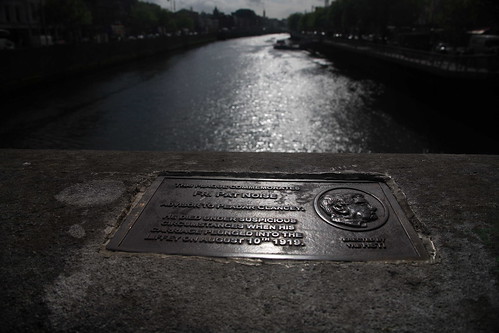
Towards a Ballad of Father Noise

The wording on the plaque on O'Connell Bridge:

THIS PLAQUE COMMEMORATES
FR. PAT NOISE*

ADVISOR TO PEADAR CLANCY*

HE DIED UNDER SUSPICIOUS CIRCUMSTANCES
WHEN HIS CARRAIGE PLUNGED INTO THE LIFFEY
ON AUGUST 10TH 1919

ERECTED BY THE HSTI*

I recently learned of that plaque on O’Connell Bridge commemorating a certain fictitious Fr Pat Noise. Though it has apparently been there for two years I never noticed it. Neither did Dublin City Council, which is now intent on removing it without any consultation with the public. This is a pity, it seems to me. Dubliners have a traditional affection for subversive characters and quirky landmarks; think of how much we've taken the Bloomsday blarney to heart (albeit half a century after Joyce's death), and how much revenue it brings from tourism; think of (I hate to say it) ghastly Molly Malone, a life-size Easter/Playboy Bunny cast in chocolate (but undoubtedly a huge magnet for tourists); think of the successful campaign to retain the old neon ‘Why Go Bald?’ sign off South Great George’s Street; think of how much we miss Thom McGinty, The Diceman.

Dubliners are also known to appreciate a good joke. This is a very good (if very quiet) joke; it is also something more, the creation of a newly-minted fictional presence, complete with dramatic narrative, that has been under every passerby's nose for two years. That is part of its subtlety; it was designed to be overlooked (since that is what one does to the walls of Dublin's busiest bridge).

I went to see Fr. Noise for myself today. In the 15 minutes I was there taking photographs I spoke to about a dozen people who stopped to read the plaque; all were enthusiastically in favour of keeping it. And why not? This (Noise in a teacup) is utterly unique, all the more so for the artist remaining anonymous, and it sets off all sorts of interesting little echoes: historical, literary, philosophical, etc. etc. If the Council wants to be pragmatic, they might consider that Fr. Noise would also provide one more little tourist magnet. He should be treasured.

It would take an imaginative leap on the part of the Council to let the plaque remain, but if enough interest is shown it just might be possible. Two whole years living under our noses. Joyce would heartily approve, as would Flann O'Brien and Jorge Luis Borges. Fr Pat Noise has secured his right to stay.

AN UPDATE: December 2006

On December 11 I sat through a meeting of the South East Area Committee in the City Hall. Ruairi Quinn had informed me about it; he knew I'd be interested because the chairman, Cllr Dermot Lacey (Labour rep for the Pembroke Ward), was putting forward a motion that the plaque to Fr Pat Noise should remain in situ. The meeting was open to the public so anyone could attend.

Some of the councillors on Dublin City Council want the plaque removed because (apparently) they don't like being upstaged, having a pair of upstart arty fartys put one over on them. The fact that the plaque was there in the first place was bad enough, but that it had been under their noses for 3 years or so really infuriates them.

The meeting was interesting enough to begin with. I had the sense of entering an inner sanctum, rather like a courtroom: a big, dully bright chamber paneled with enormous full length portraits of bewigged dead mayors and other worthies. After over two hours, trying to prop myself awake, listening to endless queries about cycle lanes, planning applications for apartments, problems with leaf-clogged gutters etc., etc....my little item was eventually raised. Grinning, Cllr Lacey suggested that the plaque should remain in place because it was "a bit of madness, a bit of colour" and that the Council should just admit that they'd been bested and leave it in place. Well, that's one argument anyway.

There were a couple of half-hearted objections, from Cllr Mary Freeman (who didn't mind it remaining, as long as it didn't set some kind of precedent). Another councillor made inarticulate noises about vandalism and defacing our heritage, till it was pointed out to him (by Cllr Kevin Humphreys) that the 'hole' the plaque was inserted into was already there, a defacement committed by the Council itself, in order to install the Millennium Clock (a luminous digital clock in the Liffey that got the nickname 'the time in the slime'). The controls for the clock had been set into O'Connell Bridge. When the clock ceased to function properly and was removed, the workers left a gap in the stonework, which was utilised for the plaque to Fr Noise.

Here it should be stressed that the two artists (brothers?) who installed the plaque were anything but 'vandals'. This was the act of people who know and CARE for their city, people who notice such things as a little rectangular gap in the masonry of O'Connell Bridge (that the Council had evidently forgotten about) that had become a collection plate for crisp packets and dead leaves.

Thankfully, Dermot Lacey's motion was carried, so Fr Noise should have a fighting chance of remaining, though the Council may find a way to remove it surreptitiously. For one thing, I understand the 'coping stone' in which the plaque is set needs replacing. If the council remove it they might just 'forget' to replace the plaque.


Photos (from top): Karl with two members of the 'Friends of Fr. Pat Noise Society', a tourist (or possibly Trinity from The Matrix), another tourist.

Karl and friends

A tourist (or undercover operative from Dublin City Corporation)

Another tourist

*PAT NOISE
May be a pun on Pater Noster (Our Father); apparently the portrait on the plaque is a likeness of the artist's actual father.

*HSTI
As Rosita Boland noted, HSTI can be read as an anagram for 'shit'. If that's the intention, it's slightly crass, the weakest part of an otherwise near-perfect creation. However, HSTI also suggests HIST, short for History. Google also turns up some acronyms: Homeland Security Training Inc, High School Technology Initiative and Hubble Space Telescope Inst.

*A NOTE ON PEADAR CLANCY
"The Heroic" Peadar Clancy (whom Pat Noise was an 'advisor' to) was far from fictitious. He was born in 1894 in Cranny, Kilrush, Co. Clare. When he moved to Dublin he involved himself in the Nationalist cause and joined the Volunteers. He was later promoted to Lieutenant after playing a prominent part in the Easter Rebellion. His own death was certainly 'suspicious':

"Two IRA men, Dick McKee and Peadar Clancy and an innocent citizen, Conor Clune, were killed on 21st November 1920, while 'trying to escape' from interrogation in the holding cells of the (night-time) Guard House at Exchange Court - behind City Hall which had been taken over for court martials. Their bodies are reported to have had tell tale signs of torture."

There is a monument to Peadar Clancy in Kildysart, Co Clare.

(information from www.clarelibrary.ie and www.dublincastle.ie)

Friday, April 07, 2006

Handholds, Footholds

Christchurch window

Most of my poems are short, rarely longer than a page. To some extent, this reflects the kind of poetry I like to read. I’ve always been attracted to shapely but sturdy little vessels: sonnets, epigrams, haiku, messages in bottles.

About 25 years ago, while walking through a state plantation in Co Wicklow, I stepped for a moment off the dirt-track and into the rows of young conifers. I inhaled the sweet-sour, needly air, took in the ash-brown dimness, heard the faint susurrus of wind in the higher branches. Even in that uniform, fledgling forest I felt a slight but definite shift, a distancing, as if a door on the late 20th Century had creaked softly shut. A vision crept over me, of Ireland’s ancient, post-glacial fur – the whole island covered in dense woodland – and a phrase came: “woods stuffy with silence.”

The first effort was a short, ten-line poem in rhyming couplets, all of which I later discarded except for that phrase. This eventually became part of the first of a four-page sequence of short poems, Footholds, beginning from a standpoint around 10,000 years ago, before even the first migrant settlers arrived on our island, and leaving off in a dreamspace crossroads in Dublin somewhere between the middle ages and the 20th Century.

While doing an MA in poetry in 1994 I read Gerard Murphy’s fascinating cribs in his Early Irish Lyrics and wrote versions based on some of these, one of which made its way into the sequence.

Footholds was first published in 1997 in the New Writers’ Anthology ‘What Will We Do When We Get There?’ There was still something that bothered me about it though; it seemed unfinished, ungainly. Some years later I brought Footholds to a masterclass with Paul Muldoon. He came up with a brilliantly simple solution, realising that the sequence broke naturally into two shorter ones (at least), the first fitting neatly on one page, ending before the evolution of early Celtic art and the written word. This shorter version was published a couple of years ago in The Shop. The rest I have tried to redraft into a three-page sequence, Handholds. I had intended to place this at or near the end of my forthcoming collection, The Sky Road, but then had second thoughts. Still too ungainly perhaps, a dropped lizard’s tail longer than the lizard.


HANDHOLDS

Spiral. We set it down where we can, a ripple
on tombs, brooches, stones, the pattern of holes
in a soup-strainer. Sacred and inscrutable, the line
has got under our skin. The scrolled-up symbol sleeps
tight, waiting to uncoil.

****

Though we’ve housed them soundly, the dead,
their voices reach us, restlessness
of leaves, grass, clouds, those words
on the tips of their tongues.

****

Safe in the firelit dark.
Safe in the sunlit wood.
Safe as a well-fenced field.
Safe as our guarded cattle.
Safe as a crannog, a ring-fort.

Still, often we tremble
like a wind-blown nest in the bramble.

****

Melodious bellnotes roll
Onto the stormy night
To comfort and console
More than women might

****

New geometry everywhere now.
The worldly raindrop, cloud-cliffs,
night and day are designed
by a different architect.
The chorus of old names has sunk
to the dark at the heart of a daisy.
Or they loiter by the old wells, stand
like shadows behind each grassblade.
They have only stepped back a little,
out of the sphere of this bright new
magic with its hard-edged symbols,
the sun + moon spiked by a cross.
Silent men sit in the woods,
not working but busy, their quill-tips
blackened with holly-juice, beetling
…………………………………….
as if the sweet breeze from a blackbird
should fit into laddery lines,
as if you could thread the wind,
as if this god could be tugged out
with a jewelled chain of capital letters...

****

Now we hear it, the voice of money
making its own rosary,
fish-eyed, splash-headed kings,
dud bells, a trickle of clinks,
metal talking to metal.

****

See, in the valleys at dusk,
pockets of glimmers, licks
of candle-light at a window.

Dreamy as the drift of sparks
that catches, for a few seconds,
in the black throat of a chimney.

A sprinkle of quick bright names
settling, or flaring like gorse
darkening into the roots

of an old song.

****

In the Liffey’s meandering dream
the sun’s scrap metal, cloud-
cargo still edges upstream

bearing one, wind-bent sail:

flutter of war-plague-fire
where dark little fingers of forest,
oak groves, bare-headed hills
in the before-dawn blue:

a shudder of wind in the leaves,
streets breathing and rustling,
bright gulls in the dark squares,
tongues in the old bells bonging,

smell of piss in an alley,
woodsmoke blown across
the bricky or glassy centuries:
corners gateways laneways

backstreets of the sea.

Tuesday, March 21, 2006

The Yahoo Road Co. 1993


The Yahoo Road Co. 1993
Originally uploaded by southsidernotes.

I was going through some old negatives recently and found this photograph, taken in the early 1990s, on one of our road-trips around the border counties. In order to capture all four of us, I had propped my Nikon on the bonnet of Danny's car and set the timer. This was The Yahoo Road Co: myself (writer/photographer), Danny (photographer), Dave (photographer) and Pat (painter).

Anyone familiar with the work of Robert Frank or Josef Koudelka (to mention just a couple) will know how well photography and road-trips compliment each other. Naturally, the very idea of the road – that long, grey, riverlike kingdom ruled by all who are mobile – presents an exciting motif for artists and writers too.

The initial idea had been to travel up North and look for anything strange or startling to photograph, in particular the thriving Country and Western scene. After some debate it was decided that such a venture would be too much like Troubles-tourism, street-naivety masquerading as journalism. Instead, we opted to just take off on the occasional long weekend, whenever we could find time, driving mainly through the midlands and border counties, stopping whenever we saw something worth photographing (or painting / taking notes on) or just because we felt like it.

Of course, the word Yahoo has a different connotation now. Our modest enterprise had nothing to do with dotcom empires or information highways. We wanted a group-name that would carry some flavour of what we were about on the far less streamlined Irish highways and byways, some small sense of wildness and cutting loose, of backroads adventure. Oddly enough, some lines from the end of John McGahern's novel, The Pornographer, came to mind, where two of the characters are driving somewhere beyond the last page and one of them calls out (to the road itself) ""Yoo-hoo, Road. Yoo-hoo, Road. Yoo-hoo, Road. Yoo-hoo . . ." I changed yoohoo to yahoo partly as a gesture to our original impetus, a look at the C & W scene in the border counties (yeehaw!). Also partly to our sense of male comaraderie; these trips were about friendship as much as anything.

The closest we ever came to investigating the C & W scene was during a weekend when we were kindly put up for a few days by The Tyrone Guthrie Centre at Annaghmakerrig in Co Monaghan. From here, we arranged to visit the legendary Big Tom And The Mainliners, who were playing not too far away: a dim, half-deserted hall at the back of a pub in a Republican border town where we were regarded with hostile suspicion (West Brits with cameras and nervous eyes!), but that experience is a story in its own right.

Because of its immediacy, photography was the dominant mode. Painting came second, writing a distant third. Anything might catch our eyes: late sun slanting through a field, the kitsch-palatial gates of some millionaire's inflated bungalow, a junkyard with an angry dog on a loooong chain, an official-looking road-sign nailed high on a scraggly, ivied tree stating THE BORDERLORDS RULE. We would scan the local papers for interesting events: a massive disco in Monaghan where people came from both sides of the border, a St Brigid's Day Procession down dark country roads in Louth, female mud-wrestling in the bowels of some cheesy midlands hotel...

Though I've said that photography was the dominant mode, Pat's paintings were among the best works to come directly out of our loose, undisciplined rovings, his nightscapes from the Brigid's Day procession in particular. That simple, calendar event affected us all. Not that there was the slightest chance of any of us being converted (or reconverted) to Catholicism, but the hushed, crowded, intimate atmosphere made inroads; the memory still holds.

I produced a number poems relating to Yahoo Road, redrafting them over the years and eventually whittling them down to less than a handful, including the following sonnet, from my second collection, The Sky Road:

Night Procession

No sign of Faughart on the roadmap. Our dark
island kept itself to itself, one high-hedged bóthar
headlit, the same as another. Then, out of nowhere
it came to us, a long-acre of parked cars
we added to. Nothing to do now but go
with the cattle-press of the procession, its shuffle
a low-voiced, slow, inevitable river uphill.

Nobody minded us, unbelievers suspended in the flow
of candles and wobbly torch-beams. Our wariness lapsed,
shrinking as the night-eye opened. Passing a gap,
we heard softly trumpeted, familiar notes doodled
across clouded moonfields. Forgotten, remembered:
Faith of Our Fathers. As if it wasn’t if, but when.
And your whisper in my ear: “We’re going to Heaven.”

Wednesday, January 25, 2006

Gone to the blogs


My granddad, viewing earth's worn cogs,
Said, "Things are going to the dogs."
His granddad in his house of logs
Said, "Things are going to the dogs."
His granddad in the Flemish bogs
Said, "Things are going to the dogs."
His granddad in his old skin togs
Said, "Things are going to the dogs."
There's just one thing I have to state:
The dogs have had a good long wait.

(Anon)

Dogs have been on my mind of late. My wife's family suffered the bereavement of their old dog Sally (a kind of bloodhound I think), and have now adopted a Jack Russell puppy, Pippa. I am not sure how Hector, their aging Alsatian, feels about this. But our one and a half year old son, who was a recent visitor (16 acres, half of it woods!), has found a soul mate. He and Pippa spent two days blissfully barking, chasing each other’s tails, nipping each other’s heels and so on. So much for him learning to talk. Dogspeak is far more fun: "so elegant, so intelligent."

Mark Doty's new collection, SCHOOL OF THE ARTS, abounds in canine concerns. There are poems about dogs and ones dedicated to dogs, such as 'Heaven For Beau':

"On one of his last walks, he stopped
near the corner of Thompson and Prince,

nostrils startlingly wide with the scent
drifted from a lunchstand soup kitchen's

open window. Believe me,
a dog's gaze opens, like ours,
when the world's an invitation..."

Of course there are also poems in it about (or featuring) people. He has a nice one about giving a hyacinth to Stanley Kunitz for his birthday, called, naturally, 'Heaven For Stanley'. Kunitz is an avid gardener apparently, and Doty's poem celebrates the cherished impermanence of flowers and plants, setting this (as one does) against his art: "I had thought poetry a brace against time,/ the hours held up for study in a voice's cool saline,// but his allegiance is not to permanent forms./ His garden's all furious change,// budding and rot and then the coming up again..."

And this of course, also, is where Doty's allegiance lies, those lines from 'Homo Will Not Inherit': "I'll tell you what I'll inherit: the margins." Such as, in that particular poem, steam on city streets. Dogs would approve.

'Letter To God' is an amusing fable (a kind of shaggy dog poem) offering a unique explanation for why dogs sniff each other's behinds. The original dog-ancestors elect to send a missive to God, pleading for an end to their suffering. The messenger is a retriever, who of course fails to return with an answer.

I wonder if Doty got this idea from another poem/fable, Heaney's, 'Tonight A Dog Was Crying In Wicklow Also'. It's about a similar petition to God (or Chukwu), this one from humans who wish to put a stop to mortality. Heaney's does not have a comic-erotic element, but is beautifully elegiac. As in Doty's poem, the messenger is a dog who gets distracted (by a toad in that instance):

"And that is how the toad reached Chukwu first,
The toad who'd overheard in the beginning
What the dog was meant to tell. 'Human beings,' he said
(And here the toad was trusted absolutely),
'Human beings want death to last forever.'

Then Chukwu saw the people's souls in birds
Coming towards him like black spots off the sunset
To a place where there would be neither roosts nor trees
Nor anyway back to the house of life.
And his mind reddened and darkened all at once
And nothing that the dog would tell him later
Could change that vision. Great chiefs and great loves
In obliterated light, the toad in mud,
The dog crying out all night behind the corpse house."

I once drew a cartoon about Dublin dogs, called 'Gurriers'. I still have the first strip somewhere, which I sent in to IN DUBLIN, who weren't interested, unsurprisingly. Maybe I'll post it here if I can find it.

We have kept only cats since our last dog, Terry, ambled off one day in his obese, arthritic old age, some 25 years ago, never to return. Maybe dogs, like elephants, have their secret graveyards. And whether we keep them as pets or not, they shadow the borders of our lives, sometimes stepping briefly into the spotlight, so that we can't, for some reason, forget them. Like that one I saw when I got off a plane in Athens:

Glass airport doors slide
wide, for a lame dog, Argos,
in from the Greek sun.

Monday, January 16, 2006

Transvestite Hermaphrodites

This is what semicolons are, according to Kurt Vonnegut in an extract from his forthcoming memoir (The Guardian Review, Saturday 14th January). A few paragraphs about war (and whether or not to talk about it) are followed by a brief lesson in creative writing:

"First rule: Do not use semicolons. They are transvestite hermaphrodites representing absolutely nothing. All they do is show you've been to college.

And I realise some of you may be having trouble deciding whether I am kidding or not. So from now on I will tell you when I'm kidding.

For instance, join the National Guard or the Marines and teach democracy. I'm kidding.

We are about to be attacked by al-Qaida. Wave flags if you have them. That always seems to scare them away. I'm kidding.

If you want to really hurt your parents, and you don't have the nerve to be gay, the least you can do is go into the arts. I'm not kidding. The arts are not a way to make a living. They are a very human way of making life more bearable. Practising an art, no matter how well or badly, is a way to make your soul grow, for heaven's sake. Sing in the shower. Dance to the radio. Tell stories. Write a poem to a friend, even a lousy poem. Do it as well as you possibly can. You will get an enormous reward. You will have created something."

I can dig this kind of dogmatic humour: shooting from the hip, telling it like it is. Is he kidding about semicolons though? I don't believe he is. I remember the poet Martin Mooney had a similar revulsion towards them. Or maybe it was just that he told me about what American poet Richard Hugo said about them in his excellent, autobiographical book (about creative writing among other things) THE TRIGGERING TOWN. Maybe this loathing of semicolons (or poor old transvestite hermaphrodites, heaven help them) is largely an American thing. I understand that they are a bit fussy and fiddly (Hugo thought they were "ugly" if I remember right). But they do serve a function, being less absolute than a full stop and more absolute than a comma. Okay, you could just use a full stop, or a comma as many poets do, or an extra space or two or a Dickinson – dash.

Maybe KV has pinpointed a weakness in my work; vagueness, an attachment to in-betweeness, to things that are neither one thing nor the other. Still, I find it hard to take issue with innocent bits of hard-working punctuation minding their own business.

Friday, January 13, 2006

Wednesday, January 11, 2006

Southside streetlight


Autumn evening, southside
Originally uploaded by southsidernotes.
I've been photographing suburban night or evening scenes for awhile now. Here's one of my recent ones, taken from near the house where I live. I was struck by the way the streetlamp highlighted the colour of the leaves.